


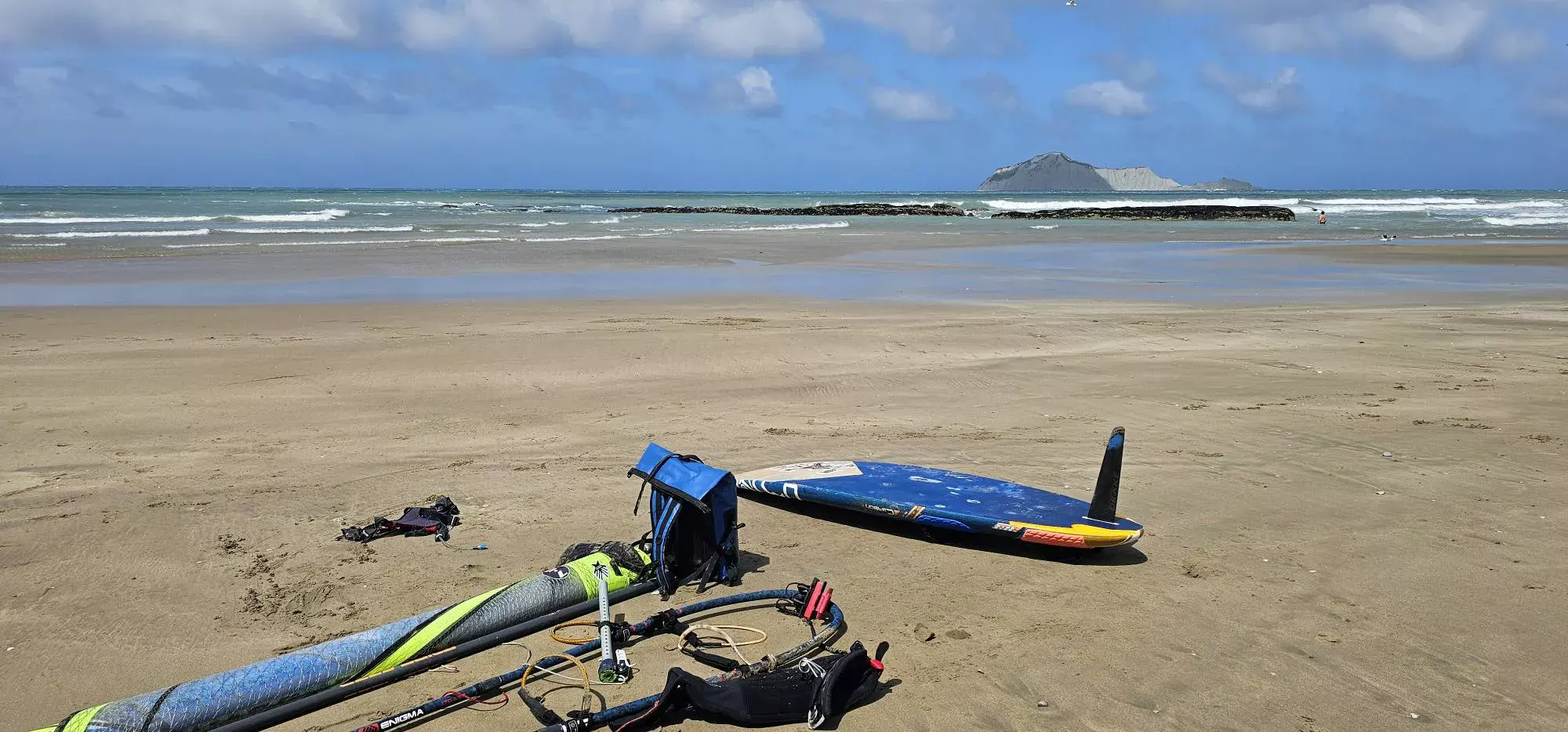
While his social media page gathered traction and plenty of windsport enthusiasts followed his adventures, few knew who is actually behind this awesome adventure. Piers is not after publicity and likes to keep things private. This mission, that he signed himself up to, is purely for himself, to have fun and enjoy the country.
We met Piers windsurfing on Rabbit Island, when he told us about this windsurfing trip in the North Island he was planning for the new year. We thought he was talking about a road trip! Only a few days later, when we saw his first post pop up on Facebook, did we connect the dots that he was talking about an actual windsurfing trip!
As this is an adventure absolutely up our alley, we were super keen to catch up with him after he retired for the season to tell us all about it. We spoke about how he did get into windsurfing and came up with the idea about circumnavigating New Zealand, how he planned and prepped the trip, and of course about the journey itself. He generously agreed that we write a blogpost, under the condition that we keep his identity a mystery.
So here you go:
How long have you been windsurfing and how did you get into it?
I’ve been always interested in wind sports and I started windsurfing when I went to university in Christchurch. Though I only did about a year of windsurfing at uni and didn’t touch it for years after that.
I did a little bit after I moved to Havelock, but the Marlborough Sounds weren’t such a good place to windsurf. Once I moved over here (Moutere) I decided to get some proper gear and do some actual windsurfing. So I’ve only really been windsurfing for eight, nine years.
Do you do any other windsports, like kiting, winging or windfoiling?
I kite and I windfoil. I’ve done some wingfoiling as well, though not much. What I enjoy about the windsurfing is that there is always more to learn. When it’s not windy enough to windsurf, I take the foil. But as soon as I can, I go back on the fin. I’ve also got wheels (windskate), which are pretty fun. But again, it’s not windsurfing. It’s racing up and down the beach, but it’s better than nothing.
How did you come up with the idea to windsurf around the North Island? How long has that been cooking?
I’ve been thinking about it for a few years. While living here in the Nelson area, I windsurfed back and forth across Tasman Bay between Motueka and Nelson. And then from there, I was wondering where else I could go. Maybe I could go to Able Tasman or D’Urville Island, just windsurf a bit further.
Did you get there?
I didn’t actually do those ones, but decided to go across Cook Strait instead.
After having been across the Strait and back and doing it with some mates, I was looking for my next challenge. The North Island seems like a good trip.
I started doing a bit of it last year when I went up to Auckland to grab some gear. I started coming down the East Coast but there just wasn’t enough wind, so it didn’t go that well. But it gave me an idea of what kind of things I might be getting myself into. I did a quite good run along the south coast of Taranaki. Though it was too windy to get a really good downwind, I was constantly ploughing into waves and flying over the front. But yeah, it was good to see that I actually could get out there in the big waves. And while it was tough going, I could always get back to shore, there was always a way back.
So yeah, from there on, I was like: “Well, let’s go around the North Island!”
Did you get inspired by Jonno Dunnett or someone like that?
No, not really. I mean, I heard of him, but it was more that I wanted to do this trip and then I started researching: “Oh man, is this possible? I wonder who is doing things like this?” And his name popped to mind, and also this English guy, Henry Cartwright, who sailed along the South Coast of the UK and across to France. He also sailed from Scotland across to Ireland and back to Scotland.
There is also a guy (Maciek Rutkowski) who just windfoiled across from Poland to Norway. And here in New Zealand there is Luke Wiggelsworth who has done the Coastal Classic several times and Jarrod Armitage, who actually windsurfed around the North Island before.

How did you plan your trip? First of all, how did you manage to get time off work?
I’m self-employed, so I can just take off whenever I want to.

You’ve got that nice map over there. How did you plan or scout out your landing spots?
I was looking on Google Earth for sheltered sandy bays to land in. You actually choose the bays that are sheltered more for launching back into the water than for getting out. It’s very easy to get out of the water, worst thing you kinda wash up when there are waves. But it’s hard work to get out through the waves. So most of those places are bays that I can get back out of.
And then they are also mostly places where I could buy food and find a place to sleep. If there were people who offered me all of these fantastic things, then that was a bonus, but I didn’t want to rely on the charity of people.
I’m surprised you’ve got that many spots around the East Cape.
That’s an anomaly. There’s not that many supermarkets around the East Cape.
I’d populate the map with the preferred places (safe exit and entry plus supermarket) first, but there are areas with maybe 80km or so between those good places, which is too far. So I chuck in a couple of extras where I could land. You don’t really want to, but these are places to get out, have a night’s sleep and get back on the water the next day.
Basically, when I’m on the water and things are not going to plan I can quickly get my Google Maps open and check where the best place to go is. They are already tagged, rather than having to zoom in and find a good place. Fortunately Google Maps work without reception if you download it. Not the satellite image though.
My daily planning always included a buffer to get to land. I would plan to be on land by 3 o’clock. Because then, if I haven’t quite gotten to where I want to go, I had two more hours to get there. And then it’s 5 o’clock and I’ve still got two hours to get to land if I ended up swimming. And then at 7 o’clock I’ve still got an hour or two of daylight in midsummer. So, you know, there was a huge buffer zone there.
Only once did I land and had only an hour and a half of daylight left.
So pretty much, if by 3 o’clock I haven’t got to where I wanted to go, I’d stick close to shore from then on. So I’d never be way out offshore with only three hours of daylight left.
Wasn’t it tempting on a good day just to keep going and making the most of the conditions?
No. On those nice days, I’ve been going since 7 o’clock in the morning. So when it got to 3 or 4 o’clock in the afternoon, I was tired already. The one day I went all the way to Tauranga, I think I finished at 6. That was a long day. Around 4 o’clock I got to just before Waihi and looked at going in there, but it probably would have been an hour and a half to tack upwind to Waihi. And it was probably only two hours on a beam reach to get across to Tauranga, which is a lot nicer sailing. So it actually made more sense to keep going. It would also be the better place if I did get stuck, because there were plenty of boats around there.
I had it all planned out that I was going to be there by 5, 5:30pm, but then the wind died at the end which set me back a little bit. I still had two hours of daylight even after I landed.

What do you carry on food and water?
I carry two and a half litres of water, one and a half in the camelback and another litre in the bag. I ran out once and went to shore to refill. But that was before I had my extra litre. Having the extra litre in the bag is good, because it is weighted at the bottom of the bag and I can just sit down and rest and transfer it into the camelback.
What do you carry on food? With that amount of energy you are burning I reckon you need a fair bit of food. A single package meal of Back Country wouldn’t do it.
No, two of them for a meal.
And what do you eat during the day?
During the day I eat high energy bars like OSMs and Musashi bars. On a long day I go through five or six of them. Even then, I wouldn’t have enough food to continue windsurfing for days on end. I have enough food to get me out of trouble. If I’m walking out, that’s fine, I’ve got two days worth of food. But if I want to go windsurfing the next day, then I’ve probably only got one night of food. But I didn’t notice that I was overly hungry most of the time. It was only when I stopped that you’d notice that I’m eating two meals for every meal for three or four days. And then finally you find you’ve eaten enough and you can eat normally again.

What windsurf equipment did you use?
I started on a 109 litre Starboard Futura. It was very good, because I’m about 70, 72kgs and I could stand on it and hoist the sail up. But only just, which I found out didn’t work when the waves got big. So I got really good at waterstarting, holding the bottom of the mast and the loop of the harness lines. I could waterstart probably in anything over 5 knots, which I felt was pretty good.
There is this wind range of 2-5 knots, where if you were on the board, you could be moving, but if you’re not on the board, you’re obviously not moving. If there was any kind of waves, I couldn’t uphaul, and I couldn’t waterstart because there wasn’t enough wind. Which means anything less than 5 knots, I couldn’t really use. That was the biggest downfall of the board. The rest of the time, it was great. It was short enough to bob up and down over the waves. It bounced and crashed around a little bit in the chop, but, you know, it’s a big flat board and you’ve got to have some compromise.
And you used a 7.5m sail?
Yes, a 7.5m Ezzy sail. I didn’t really plan on this huge mission when I got the sail. As it turned out, the Ezzy was perfect for it. It has a great wind range and it’s got the reinforcing throughout the whole sail. So even when I did put a hole in my sail, it didn’t rip through, it was fine. Whereas with some of my other sails, when you put a hole in it, the sail is in half!
I’ve still got that sail, though the Futura gave up the ghost eventually and I ended up with a Mistral One Design longboard for two days, going down from Auckland to Tauranga.
Although the longboard was great in wind below 12 knots, I didn’t really enjoy it too much, it just wasn’t my style. And if the wind is over 12 knots the slalom board works fine. The longboard would be a handfull in bigger seas, and let’s not even talk about landing and launching off the beaches and transporting it around!

I got a Patrick 122 litre board, a little bit bigger and slightly flatter on the bottom than the Futura, but apart from that very similar. It was a little bit bouncy on the waves but I could stand on it and uphaul on it, even in choppy seas, which was nice. And it still stayed in control. It was only in the flat water when I went blasting along that I got the nose up in the air. But even then you just rearrange it to pin the nose down: Slide the mast a bit forward and just loosen out the sail a bit which gets a bit more of that forward pressure.

So you had an adjustable outhaul and the North ratchet for the downhaul?
Yes, both of those. Very useful.
The other thing I found useful was being able to slide the harness lines back and forth and changing the length of them. I was adjusting the trim of the sail as much as I could. But I was going outside the usual conditions, I was pushing the sail to the extremes. Instead of getting a lot of backhand pressure because there is too much wind, you just slide the harness lines back a bit, which helps a huge amount. I also started doing this cross footing, where your front foot is in the front footstrap, and your backfoot is in the opposite footstrap at the back, which made going downwind more controlled. Your stance and your balance across the board changes completely, so having harness lines that slide up and down the boom was pretty essential.
As a fin, I had the 42 Drake Slalom, which was pretty good. If I could, I would have a variety of fins, because I think it’d be nice to have a more raked back fin for downwind to keep your nose up. Or a bit of a curved fin for playfulness around the waves. But I needed the straight slalom fin to get upwind.

Tell me a bit about your actual trip.
The plan was to windsurf clockwise around the North Island, so the actual trip only started once I got to Wellington. But to get all the gear to Wellington, it was easier just to windsurf across from Blenheim. It was a bit tricky getting all the way into Wellington, because if you just go across the Strait, it’s about 30 k’s. Getting into Wellington itself is 60 k’s. And the wind was a little bit further east than I expected, so I had to tack upwind a bit. And I remember the Karori Rip was huge. I crossed it in slack tide first which was amazingly flat. But then I ended up inside the Rip and had to go through it to get out and then come back around the outside. By then the tide was moving and waves were 4 meters coming from all directions. It was mayhem!
I intended to stash my gear in Wellington for a bit and wait for the weather to improve. But then there was a good day to get around the SW-corner of the North Island to Porirua. That corner wasn’t going to be very fun, and I would need perfect weather to get around it. So this day was perfect weather: The tides were right to get through the Karori Rip, the wind was the right direction and the right strength and the sea state was pretty flat. The only problem was that I’d already booked my flight back home for the afternoon. I calculated that I should be able to get around the corner and get back in time for my flight, which I did. I caught the train back and actually ended up with plenty of time. It took away that corner. Next time I could start in Porirua, which is much easier. So I went back home and waited for the right weather window to continue.
When the weather looked good to carry on from Porirua, I booked my tickets to get back over and do it. But then the weather changed significantly and it looked much better to go around the bottom east coast (anti-clockwise). That southeast coast is very remote and rough, there is very little down there. It was perfect conditions, I had to take it: After tacking out of Wellington’s Lyall Bay, it was a straight line all the way across to Cape Palliser, where I needed a few more tacks to get around the actual cape. From there on it was downwind, because the wind hadn’t turned quite enough around the corner. That was much harder work. But even so, I got all the way around to Te Awaiti, which was pretty much the only sheltered bay that I would be able to launch from again, and it was only four o’clock. Though I hit the reef when coming in, which sent me flying over the front of the board. My first landing and boom, straight into the water! Oh, this is not looking good. I was lucky not to take that finbox out. I had an awesome first day, that was like 120, 130 kilometres I think.
The next day was from Te Awaiti all the way up to Castle Point. That was two days and I cleared the worst of the Southeast Coast.
We were following you on Facebook and it looked like you had massive days.
Yes, though that second day was only 90km. But it was all downwind. It was a straight line on a very broad reach. Hard work. That’s where I really hammered my back leg and I felt that for weeks afterwards.
At some point I landed on the rocks and I had to walk along the rocks on my bare feet. That was when I decided to have booties. Not because of walking on the rocks, walking on the rocks is fine. It was because of putting your foot in and out of the footstrap when they’d been in the water for six or seven hours, the skin on the top disappears. Since getting the booties, I had no problems with my feet anymore, which was nice. I only wear them on the board and take them off when I’m walking around.
From Castle Point I carried on up until the weather got too rough and I was quite damaged. Body and gear, both were quite damaged. So I went home to get some rest and recover.
After I returned and carried on, it was often a case of sailing for a few days until the wind would run out. You look ahead and you’re like: “Well, there’s no wind for a week. I might as well go home and return to where I was when the wind is back”
I did that a couple of times getting up to Napier.

Did you just stash your gear pretty much where you landed with someone?
As long as it wasn’t damaged. The first time I left all the gear where I landed with the guys who would put me up. I brought home things that I could carry and I could repair, like battens and the fin. I then just had to take things like epoxy back, to fix the board. But getting to Napier destroyed the board completely. Well, not completely but enough that I didn’t really want to carry on with that one after the footstrap plug came out. It was already delaminated and had repairs on it before and I wasn’t sure about the fin box anymore.
So I had to get a new board. I managed to get a relocation car online, fitted all my gear minus the destroyed board in the back, and drove over to Auckland.
Then it was a case of: Do I grab gear and go back to Napier to carry on, or do I just go from Auckland and do something from here? I was never committed to doing an all-in-one jump. I’d already taken breaks, I’d gone a little bit one way, a little bit the other way. So by that point, I thought I might as well just make the most of the weather and make a track that links up eventually. It doesn’t have to be all in one go.
The weather was not looking great to go around East Cape, but it was looking good to go down the Coromandel. So I just went from Auckland down the Coromandel.


What were your Highlights on the trip?
I like crossing Cook’s Strait. It’s the most consistent wind and riding the swells is absolutely brilliant. I also loved seeing the orca at Cape Palliser, but the best was finding people waiting for you at the beach after a long day out.
You mentioned you sailed across Cook Straight before you started your North Island Mission. Tell me more about that.
A few years ago I did a couple of runs over a weekend, but it didn’t go too well.
So I decided to wait for a nice week of good weather. During that week I went out basically every day to try to get across. Each time I tried, the wind got stronger and stronger and I had to turn around. Except once, when the wind died completely and I had to swim back. That wasn’t fun. It was a long swim and there was a lot of current out there.
It took me about five tries before I finally got all the way across. I landed on the other side, amongst the windmills, in the middle of nowhere. I was sitting on this beach with no road access, nothing – so I decided it would be just as fast to go back. So I turned around and went back.
Where those attempts all unsupported?
Yes, that was unsupported.
The first time I tried it, I did let a few of my mates know. The wind wasn’t quite cooperating and I was out longer than expected. There was plenty of daylight left, but my mates where all panicking. So the next time I went out, I didn’t tell anyone except one mate who is sensible.
Last year I went across with a few mates who were all on wingfoils. We had a really good, seaworthy support boat, and I was on the windsurfer.
They took off and were all over the place. Some of them could cut upwind very well while others were going downwind because the wind was too light and they were splitting up. At the beginning, it was fine, because there weren’t many waves and we could see them all. Because I knew it was going to get rougher and we would start losing people, I ended up doing laps around them trying to herd them up. Eventually the downwind guys did get picked up by the boat, while I carried on with the upwind guys. We got to about the Karori Rip, and by then I just couldn’t see anyone anymore, they all disappeared. By then it was only 3 of us left on the water out of 5 or 6 at the start, the others had been picked up, which was good. By the time they picked me up, there was one other guy in the water, but we had no idea where he was. We just carried on until we saw him and picked him up. That was like: “Oh, thank God”. He was ploughing through the Karori Rip. Oh yeah, that was fun!

Did you have any disasters or near misses on your trip? Anything that could have gone very wrong?
Yeah, right at the end. I came out of Otamuri Bay, which has got a double reef, so it’s nice and sheltered inside. I made my way out and came around the top, thinking I could just go straight across. The wind was the right angle, I should just get in front of the rocks, then all the way across and I would be out and gone. As I got closer to the rocks, I realized that I actually wasn’t far enough out, and I had to turn around and tack further out. It was quite wavy and I didn’t make the tack, so I was in the water, about probably 60, 70 meters away from the rocks. There were waves coming in and breaking on the rocks, and I’m trying to turn all the gear around and get back up. That’s when the wind died, I’m starting to drift further in, and it’s all going terrible. The closer you get in, the less wind, the bigger the waves. I was starting to watch those breaking waves and I knew I was in-between sets. There would be a set coming at some point that was probably going to be washing over me, with white water on the sail. I was panicking a bit because I had to get out of there before the set came. It was a close call but I made it. If the set had caught me or if I had gotten any closer to the rocks, then I probably would have just ditched my gear and started swimming.
Apart from that, everything else has been pretty good.
You get five, six miles out from the shoreline, sometimes ten miles, and then the wind dies. That’s not much fun, but as it would only be early in the day (you wouldn’t be out that far in the evening), you just sit and chill and wait for the wind to come back.
At 10 miles offshore, are you out of sight of land?
No, not quite. You would be if it was flat land, but it’s hills, someone on a beach would not be able to see you.
Ever have any thoughts about the change in visibility?
There is a couple of times where I couldn’t see where I was meant to be going. So you just assume it’s got to be that way somewhere, judging by the wind direction and how the wave lines are and my general direction that I’ve been going. Every now and again, I’d check my track on my phone to confirm I’m still going in the right direction.
So pretty much your direction finding’s dead reckoning by conditions like traditional sailing?
Yeah, it is.
But even when you can see, a lot of times you look ahead and you think: “Oh, that must be that point!” And then you get there and you realise it’s not, it’s the one before. Coming down the Coromandel was like that with all the islands.
Did you have any routines during your trip, regarding starting, sailing, landing, setting up camp etc.?
Apart from starting out early in the morning to have more time on the water, I didn’t really have any routines
What happens when you land on a place, how do you find food, accommodation, anything?
I just walk around.
A few times I’ve washed up on a beach and someone’s just been walking past. And they are kind of like: “What are you doing here? People normally don’t windsurf here.” By the time I finished explaining and am asking for a campground, a hotel, or just a good place to set up a campsite, they’ve often offered me a bed, or they knew someone who could put me up for the night. That usually worked out pretty well. At one point I was even offered a deserted bach to sleep in!
A couple of times people have come down to meet me on the beach because they’ve been following me, which is cool. They usually come down and they’re like: “Right, nice to meet you. Cool, where’s your support crew?” “No, no, it’s just me.”
Sometimes I’ve had to go wandering and you just walk along until you find something and talk to the locals.
So you only had to sleep under your sail once? That must have been a cold night.
Yes. That was actually quite warm. I mean, it was a warm enough night. I had the emergency thermal blanket and all my clothes, three layers of merino and a rain jacket. I was warm enough to sleep comfortably. Though the ground wasn’t very comfortable. Actually, the ground was comfortable, but it was like a 40 degree slope and I was constantly sliding down. Curl up this way, curl up that way. But, no, it was surprisingly relaxing. I got a good rest that night. I didn’t sleep a lot of it, but I did rest very well.


Did you have many marine life encounters?
Not really, no. I was expecting a lot more. I saw orca down at Cape Palliser and dolphins a couple of times around Napier, Coromandel and the Bay of Islands. I saw quite a lot of flying fish from Castle Point up to the Bay of Islands. They were fun. They’re like dolphins, you know, they jump out in front of the sail and fly around in front of you and then disappear. A saw couple of schools of fish, a few sharks. And then not even that many seagulls.
Expectations versus reality. Did it match?
Yes and no. I expected to average about 100km each day, and that’s what I did. But I expected the wind to be better. I hoped for 4 days out of 7 that were good enough to go out, but it turned out to be three or four days in a row and then nothing for a week.
The wind also didn’t match the forecast very well. It stated 20 knots easterly all day and when you got there, it’ll be 20 knots for an hour, then it’ll die for half hour, before coming back with 15 knots. Though I think part of it was because I was covering such a big distance each day: You can’t expect that 20 knots of easterly in Napier to be 20 knots of easterly 50km out off the beach. It’s a completely different place! So yeah, that’s something I didn’t really count on,
Other than that, the gear did very well. I mean, I broke the first board, but that was kind of… I didn’t expect that board to last too long. It was already on its way out before I started.

You mentioned you are planning on carrying on next summer. Anything you would change on your set up or do differently?
I think I’d keep all of it. I’ll get a new sail, because the sail is starting to get worn, it’s got a few holes in it. It’s still fine for around here but if I’m gonna go a long distance I might as well start with something that is good. I think I’d keep the board, I like it. And the fin. I haven’t really tried with different fins. It would be interesting to try something different, but I don’t want to lose that upwind ability.
If I had a ground crew, I could take a variety of sails and a variety of boards and fins and everything like that. But it still comes down to on the day, you’ve got a variety of wind conditions anyway. So you would need to come in to change it over.
I think if I had a ground crew, it would just be a boat to collect me if I couldn’t get back to shore by myself. With a boat, you could plan differently, you wouldn’t need such a big safety buffer. You could go for longer each day. Though the priority is to do it myself. The boat’s not there as an easy out, the boat’s there for an emergency. I wouldn’t want to use it if I didn’t have to.
What about your backpack and things like food and clothing?
I think it all works. The backpack that I’m using is a fantastic backpack, it’s completely waterproof. You pack to be as light as possible, but I don’t feel the backpack on my back, so I could put more into it. There is no point in having empty space in there, I might as well fill it up and put an extra layer of warm clothing in.
Did it not get in the way when waterstarting or swimming?
No, not really. It did throw me off during all my turns though. You start jibing, and then with the backpack on you suddenly get thrown off because the waves hit you and you can’t balance in time to get around. So I ended up not really turning much and mainly doing chicken jibes, just throwing the sail over and jumping off.
I think I had everything I needed and nothing I didn’t.
Any tips for any aspiring windsurf adventurer?
Get out there! Get a bunch of people and do it as a group. Let someone know what you’re doing, but then, just go for it!
I think people can take more risk than they appreciate, people shy away from doing things because they think it is too risky. They think if something breaks or something goes wrong, then they are in big trouble. Though it’s actually not that big a trouble if you’re prepared in advance and you’re willing to accept the outcome. Like, I might go out there windsurfing, but I know in the back of my mind, that I might need to swim for 2 hours. And that’s just how it is.
I’ve gone out on my board and swam around for a while just to see how quickly I could swim the board. It’s all preparation. You go and try it and see what you can do so that you know what you need to do when things go wrong.
I know, there’s people that go out and they get swept away out to sea because they haven’t got the experience or have just got the wrong kind of conditions. That means they’re not prepared. But then maybe they could have gone sideways instead of trying to tack back up. Or maybe they could have swam, maybe they could have ditched some of the gear and paddled back. Or if they’d thought about it, they might have been fine. Or worst case scenario, maybe they should have taken an EPIRB with them or some kind of device.
There’s always things that just go completely wrong and you can’t do anything about it, but that could happen to anyone. Just because I’m out at sea, that doesn’t mean I’m at a higher risk particularly. I have got the skills and I have got the knowledge to read the weather and know what’s probably going to come. You could liken it to people going out tramping.
With the right experience and preparation, you’re not feeling particularly vulnerable when you’re all the way out there. Not worse than you would be when you’re out in the mountains hiking.
I make sure I’ve always have got plenty of time left in the day, but at the same time, I’m prepared to sleep on the board if I have to. So essentially, I’ve got 48 hours to sort myself out – and that’s a long time to get something sorted out.
So yeah, get out there if you can! And make sure you’re back on land by 3 o’clock or close to it.

If you want to know more about Piers trip and are keen to follow him next summer when he gets back into it, head over to his Facebook page. And if you see him wash up on a spot near you, you know what to do: Offer him a hot shower, a bed and a warm meal and he will be forever grateful!
You can read about Jarrod Armitage’s trip around the North Island here.
All photos supplied by Piers. Thank you for letting me use them!
Looking to travel New Zealand? Check out Water Nomads for Watersports Rental and Surfari Trips!
Join the Water Nomads Community
Loading assistant…
Join the Water Nomads Community
Pop in your details and we'll email the brochure straight over.


