


Dave Smithers, better known as Biggie, is a well known figure in New Zealands windsurfing scene. Although he has now moved on from windsurfing, he is still firmly involved with the watersports industry. In the early 80ies he inovated the PVC sandwich contruction for windsurf boards under his brand name Sirocco and is nowadays developing shapes and construction methods for Armstrong.
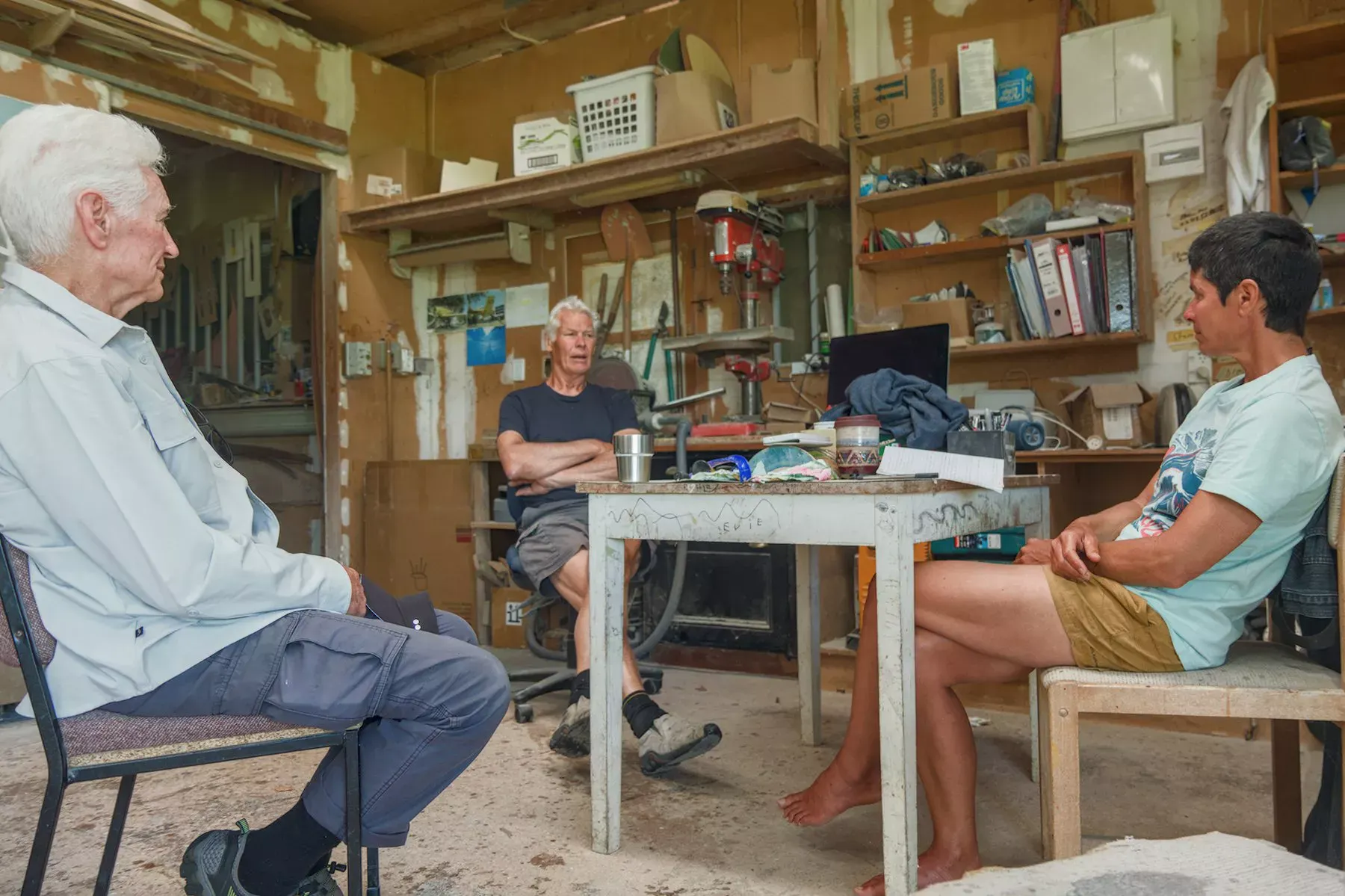
We are sitting down with Biggie in his workshop in Oakura, Taranaki. Graham (Currie), another one of the Taranaki originals and a good mate of Biggie, rocks up and joins in, adding the odd dry comment in our conversation and putting things in perspective.
The second part of our interview covered Biggie as a person, this second part here covers his craft, building boards. How it all started out, his journey, and where he sees it going. We talk board contruction and shapes, but also have got some anecdotes about things that can go wrong in a workshop.
Biggie, you’ve been around the board building scene for a long time in Taranaki and your brand Sirocco is well known in New Zealand. When and how did you get into shaping and building boards?
In ‘75, ‘76 when I was about 16 or 17, I was glassing and sanding surfboards with my brother Tom (Tom Smithers Surfboards) and Ton (Ton Dekon Designs), who were shaping.
I started shaping in ‘83 or so. I worked in the board factory, but I also set up my own business (Sirocco) at my brother’s place, making windsurfers. He made the surfboards and mainly did the shaping, while I did the laminating.
Later on, around ‘87 I think, I went to Hawaii and ended up picking up the Angulo Hawaii name and the Local Motion Surfboard brand for New Zealand. For a few years I had both, Sirocco and Angulo. In the end, I decided the cost of Angulo and having 2 brands to promote just wasn’t working.
When you built the Angulo boards, did they delivered you the shapes and you would build them here?
Yes, he gave me the plans. At one stage I spent 6 months on Oahu and a little bit on Maui and worked with them over there. I was actually working in the Local Motion factory, where we were making 10 Angulo windsurf boards a week. Although the shapers were shaping the windsurf boards, nobody really wanted to finish (laminate) them. They just preferred to make surfboards in the factory. I basically needed work, so I picked up whatever I could and did all the laminating.
You were one of the first in the world I believe to make PVC sandwich windsurf boards in the early 80ies. How did that come about?
The concept of shaping to me is 10% of board building, and I’ve always been that way. Making good boards is about the construction of boards.
I haven’t got formal education, but I was always interested in the technical part of boardbuilding. Right from the start, I was a glasser, laminater and sander, rather than the shaper. And I didn’t get into shaping until later. For me, it was about figuring out how to laminate things, how to get the vacuum bag working, how to get the PVC bending.
We started windsurfing in ‘79 / ‘80 and by about ‘83 we were starting to get into shortboards and jumping. We were making surfboard style urethane glass boards and breaking them all the time. Finally, one day, I went down to Pungarehu and I had 2 brand new boards. I went out and broke both of them within half an hour. And I said: “I just can’t afford to continue doing this.” So I talked to material suppliers and asked: “What can we do?” And they said, “Well, try putting a layer off PVC sandwich foam on the bottom”.
Was this a technology from yacht building?
Yeah, it came from that. What we came up with at that stage was a urethene surfboard, along with our windsurf shape, but with a PVC sandwich skin on the bottom. Because the bottom was where it was breaking. We made quite a few of them. They ended up denting in the deck, and ultimately, they would break. But they were way way stronger. At the same time, we started playing with polystyrene and putting PVC and epoxy on. Some of the guys in Auckland were starting to do that with the slalom boards. And they were really light.
I mean, Graham had done it. When did you do it, Graham?
Graham:
Oh, when I should have been studying for my exam…..
Biggie:
He got squares of PVC and stuck them on the blank. Like tiling.
Graham:
That wasn’t the intention. But when I came to apply the resin, the PVC foam was too stiff. So I ended up cutting it in a grid fashion, so it would sit down.
Biggie:
I’ve started off by trying to stay clear of it as Graham had trouble sticking it on. Although vacuum bagging technology was there, I didn’t have a setup for it. I ended up getting drawing pins and laying up the PVC and drawing pinning it to the foam to hold it all down and putting weights on. We did that a few times and had some boards delaminate, so we got a vacuum bag setup and worked it out from there. What we would do then was vacuum bagging a layer of 6 millimeter PVC on the bottom of the urethene blank with epoxy resin, then glassing the board and polyester spraying it. Of course they were pretty heavy. You couldn’t really do that on a slalom board. Not that you broke a slalom board much because you didn’t jump it.
I basically figured at the time, that I was the first to do that in the world, although it’s fairly obvious. And then I started making a few polysterene ones and putting it on top and bottom. I didn’t put it on the rails initially, but then we figured out how to wrap it around the rails. We started actually doing surfboards like that.
I’m now showing another guy how to make PVC wraps and stuff. Because I’m 69, just about 70, I won’t be around doing it too much longer. I’ve got a huge amount of knowledge, and it’s just a nice idea to hand it on and not to waste it all, as I still do lots of things differently than other guys do.
But basically the PVC sandwich came out of breaking windsurf boards. And then it progressed to making lightweight race boards.

Throughout the ’80ies, windsurfing grew worldwide at a rapid pace. In the early 90ies, there were numerous international brands coming up, producing more and more boards relatively cheap. How did this affect you as a small board builder?
I was right up there until the early ‘90ies, when the Asians and Cobra came along with cheaper mass-produced windsurf boards and it was getting hard to be a windsurf builder.
Starboard for example were one of the big ones. They came out and they put a 1-year warranty and guarantee on their boards, basically building-in a 10% or a 5% failure rate. It was inevitable that boards would break because guys are going hard. But they said: “We make the board for next to nothing and you’ve paid for it, so we can afford to give you another one.” Whereas with me, every board I made, I made myself. I had half the country’s top windsurfers riding on my wave boards and they were really pushing them. Terry Vernon style huge jumps, and boards would break. It wasn’t so much Terry that would break them, it was the punter that was trying to do what Terry was doing but didn’t get it right, slammed down and break their board. It ended up that I was doing 25 or 30% warranties. And I just couldn’t afford it. And I just got to the stage where I said, I can’t give the warranty, and it started fading on that.
So I had to morph, had to go with the flow. I went from making surfboards to windsurfers, and then sort of back to surfboards really. Some windsurfers and lots of really fancy longboards. I was working with that guy in Auckland, Tony Reid. We had a shop on the Northshore, The Longboard Shop. He was right into those sort of things: multi stringers with nose blocks and tail blocks, inch wide stringer, inch and a half wide stringers, angled stringers or curved stringers, all sorts of stuff like that. It’s making them look nice.
For me it was just a case of work. I had a factory and guys, so we put it together.
You eventually stopped windsurfing but did get right into kitesurfing and kitefoiling. What triggered this and what is kitesurfing for you?
I got right out of windsurfing when my first hip played up and I couldn’t really windsurf until I got a hip replacement. When I got back I was surfing a bit, but got right into snowboarding. And then kiting came along, and kiting just worked for me. So I got into kiting, and I never really got back into windsurfing.

Kiting for me was about being out in the surf, so you use the surfboard and the surfboard works. I’ve never ridden a twintip in my life, never. First time I tried, I used a twintip and I buckled my knee. That was the first year, I didn’t try again. To me, it just didn’t work. I already had the surf skills and the windsurf skills. It took a little while to get the kite skills sorted, but not too long. Very quickly I got into proper waveriding. It was just natural that as soon as we go on a surfboard / kiteboard on a wave, you wanted to surf it. So we did, and we’ve got the conditions to do it.
Biggie always enjoys learning new skills and trying different watercraft. So when foiling came along, Biggie and his mates got into kitefoiling. Though the early foils where fairly crude, either focused on racing and all about going fast, or they were designed for paddling, thick and with a low aspect ratio.
It was natural for us to go kitefoiling, because we had the kite skills. There was only a few of us, that’s 6 or 7 years ago, I suppose. We stayed kitefoiling for quite a long time. The foil design was never very conducive to wave riding, so basically I said “Kitefoiling doesn’t work in the waves”, that was the concept. And then wingfoiling came along and just went everywhere. Then the foils got evolving. I’m wing foiling now. I got into it because I got into working with Armie and making boards with Armie. Basically, we were his R and D, making his prototypes.
How did that cooperation with Armie come along? Was that through knowing each other for ages?
We didn’t actually know each other very well to start with. He was looking for a factory that he could work with, and he came in here. I was the board builder, he was really the foil builder, although he built some boards. He actually comes from a boat building background, that’s different but similar skills. So we put that together. I made a lot of the prototype boards with him here.
We’d basically develop [the shapes] here until we got them refined, then we transferred them onto a computer. I’d compare to see that the computer design was the same as what I had shaped and worked it out, so he could take that shape to China and they could make exactly the same as what we’d figured out was the shape we wanted here.
Are you still involved with the development of his standard shapes?
No, not so much anymore. Progressively Armie got better at designing them directly on the computer. And as production grew, he had a lot more money behind him and he needed a lot more boards. I still make a few for him. If his team riders want different boards than what he’s got, I’m developing them.
Foilboards, and especially wingfoil boards, are very different to surfboards or windsurf boards. What are the special requirements and considerations when you’re building a wingboard compared to a surfboard or windsurf board?
Wingboards have a lot of polystyrene in it. You’re standing on the deck, a foil is attached to the bottom of the board, and the polysterene in between has a lot of movement in it. You really need to connect the foil to the deck, so once you move the deck, the board and foil responds. Figuring out how to do that while still making it light and strong, and doing it in such a way that doesn’t take forever, there’s all of those considerations. At the start, the foils were basically just ripping the boxes off the bottom of the board, ’cause we didn’t know how to put them together.
So what are you doing to make the boards stiff and strong and get that direct response? Are you using stringers?
Armie always talks about a stringer going right through. That helps, although a stringer is quite a lot of weight for not a great deal of stiffness.
Stringers help keeping the deck and the bottom apart, but you’ve still got a lot of sideways movement. An engineering principle is, when you’re bending that (top and bottom), the center of it is not doing much. It’s the outside edges. You’re compressing one side and stretching the other side, it’s the edges that are doing all the work.
It’s like a bridge that’s built with an I-beam. It’s got a flange here and a flange here, like that. Double the distance between the flanges and you get 60 times the stiffness. So it’s the flanges being further apart what gives you the stiffness. But if you don’t have the option to put them further apart, as we can find in a bridge or a building to only being this big, you make the flanges stronger, right? The way we do that is by putting a thin PVC top and bottom with our carbon either side. That’s a logical way to go. That was exactly what was happening when we started doing it on the windsurfers that were breaking. It’s the same principle.

I was doing a lot of tow surf boards for Bevan (Gooch) back in the day. He was always looking to get smaller and smaller onto these little wee tow boards, like 3 foot long, 36/ 37 inches long, it’s tiny! Basically, we had to put enough room on the nose and the tail of the board for his feet, which was one of the requirements, because he wanted to be on these tiny little boards. Going through all this trouble to make them, I thought: “Well, there’s so little of it. I’ll get some really high density PVC and just glass it back out of carbon, because it’s just this little thing.” I sent it up to him and he used it once and said it’s really flexy. And this is high density PVC with carbon on both sides!
So going back, we’ve got a lighter weight PVC core with a 3mm sandwich with carbon on each side of it and the difference in stiffness is night and day. And that’s what we’ve got in our kiteboards, so they’re really stiff.
And how did you solve the problem about the foil ripping itself off the bottom of the board?
The problem of the foil trying to rip itself off the bottom of the board had to be dealt with in a different way. There is PVC running right through the board and not just with stringers, but there are also blocks of PVC in the board. We’ve been developing that. My dugout wing board is only 30 millimeters thick where I’m standing. Because I can’t kneel, I’ve got to directly stand-up on the board. So I need a pretty high volume board which basically becomes a cigar… It’s 7 or 8 inches thick, and you’re standing way up on top of that and wobbling around. So I put it down. And the bonus of that is, I get this 30 millimeter thick deck through which the weight and strength is directly being transferred into the foil.

If your feet are down there, it’s much more stable. The thickness of the board is basically waisted mast lenght. Standing with my feet 6 inches under the surface of the board, I’ll also put the wing on top of the board when standing up and then the wing is another 10 inches odd high. So my hands are, you know, 15 / 16 /17 inches above the board, it’s like standing up with my hand on the chair. Getting up off the floor is actually really hard, I kind of have to do a downward dog sort of walk up. And I still can’t stand-up straight on the board. I stand up and as soon as I get up, I’ve got to move the front foot forwards because I’m standing wrong. I can’t stand up and just get my feet in the right place immediately. But I’ve got it sussed now, it’s basically just standing up.
It sounds like a lot of the things you developped were initially to solve a personal problem. And then it turned out those solutions were actually really beneficial for other applications too.
Well, you know, you can make a board for yourself, and it doesn’t really matter how much time it takes. But when it comes to production to sell it, there’s a constraint on how long it takes.My current wingboard is version 3.0. I changed the design of it 3 times, on the same actual board. There’s a lot of work to make the dugout, so I’ve changed the design around the dugout that’s there. Basically, I cut the rail and now it’s sort of sloped right in, made the volume a lot smaller, but also made the bottom area smaller. Because that’s much better for getting going and much less windage. And it’s a big board, so it’s got quite a lot of windage on it.


Talking board design, and what do you think about board and foil development?
It’s a new sport, there is still lots of changes happening, design is morphing. What happens is, you get a level of performance. Guys who are really good want a certain design to be able to do what they want to do. They get the design and they improved their skill level to the point where they can actually change their board or their gear because they are better at it. And so they step up with more gear and then their ability steps up because they are on better gear. A lot of the time it starts off with quite big steps, and then the steps get smaller and smaller.
Windsurfing unfortunately got to the stage where it was more important how you rigged it on the beach than how you ride it. You know, Mark Angulo said “It’s not how you rig it but how you ride it.” [People] had to have the latest thing, and this is where marketing goes. It’s not about how you rig it, it’s how you ride it. Even if you don’t rig it right, you can still ride it well. And that’s still the case. The older stuff, the stuff that’s 2 or 3 years old in foiling, still works. Doesn’t work perhaps as good for the best guys, but, you know…..
I’m sure when you buy a new one, you want the latest, for whatever reason.
What’s your latest project that you are excited about?
Well, I’ve just made an e-foil board with built-in battery for one guy in particular. He basically bought the stuff the foil drives are made of out of China and he’s putting a board and foil together, making the whole thing. It all looks like a regular set up, except the mast’s got the motor on it and the cable runs down inside it. The bottom of the board is all smooth, but it’s got the battery in and controller units and so on.
The requirements for the guy are that he doesn’t paddle at all. he just stands on his foil, rides it out, catches the wave and rides it in. So he uses a lot of battery. And the more efficient it is, the less battery he uses, so the longer session he can have. Pushing the standard foil drive through the water takes a lot of energy. We’ve put that down inside the board, so the design of the board is smooth.
It was exactly the same thing designing the boards with Armie:
The midlength board is basically all about making it go through the water as fast as possible. When you’re not on the foil, it creates drag. It’s about figuring out what those efficient designs are. Huge changes happen when boards got narrow, you know. The first one of those that I made, I copied for Armie for a Hawaiian guy. A big wave surfer, who wanted to go out in the trade winds and prone paddle. He was a clubby [Surf Life Saver] as well. So we made him a 9 foot clubby’s paddleboard, but a foilboard. I went and got a paddle board off the surf club to copy. That was a 10’6” I think that I got, but I made a 9 footer out of it. Had the sculpted out deck and all the stuff. That was pretty close to a forerunner of the midlength. It was narrow, only 20 inches wide, the mast track way forward. He used it a bit, he said it was ok. But very quickly it progressed into the Midlength, which was for winging.
A few guys are still paddling like that. Of course, they’ve got to be able to get home as well as get out there. That means they need to be able to catch a wind chop, which has very little power. You can paddle into a breaking wave easily, but when you’re trying to paddle into 15 knots, 18 knots of wind chop….. At the time we figured, clubbies (surf lifesaving) boards, have been designing the same design for years. Because they’re only about paddling fast. There’s nothing else, no other constraint on that design other than going as fast as possible through the water. So I figured they must be onto it.
Initially wing-foilboards came out with mainly flat bottoms, then the downwind-foilboards took a different approach with displacement hulls. What’s the idea behind it, how does it work?
Looking at foil boards, they always have flat bottoms, and there’s still quite a few of those guys that still make flat bottoms, as in rocker. And they’re just slow! Before it gets on the foil, you need to have rockers. Like any boat, it’s going through the water as a displacement. So you need a displacement hull, pushing the water apart but putting it back again afterwards. As soon as you’re creating an eddy at the back of the board, there’s a huge amount of draught. And so you have the curve that allows you to fit in. I mean, they’ve gone to an extreme length, you know, like the KT and stuff like that. Axis have got one as well I saw now (the Frank downwind board). The concept of that is really quite neat, with the nose and tail being really high out of the water. It’s actually a bit like my dugout. It makes it more stable because you’ve got sort of the spit of the board down in the water lower, easier to stand on, the ends are higher. There’s some good design ideas on that, but it’s again about being able to paddle up. And I mean, I can’t do it, but talk to some of the guys. It’s a young man’s game, there’s so much energy required to get going. Okay, once you’re up, you’re cruising.

Did you have any major disasters or near misses in the workshop that you can laugh about today? Any good stories?
Well, you know, it’s cold in wintertime, so to thin the resin down, I microwave it. I use mainly suncure polyester resin, so it doesn’t really affect the resin being hot. But with all the carbon around, you get little specks of carbon in the microwave and they spark. And of course, you’ve got resin in there, which has got good fumes in it. So 2 or 3 times, I look at the [microwave] door and it’s burning in there! I’ve kind of learned to watch it now. If it starts sparking, turn it off.
Way back, in the mid-seventies when I was 23, we actually have had a fire, doing the same thing: Putting resin on the floor in front of a bar heater to warm it up, then kicking the pot of resin into the heater, and it burst into flames! You know, the black ash that comes off it is all around the little factory, on the boards, everywhere. It was just such a mess, it was unbelievable. I decided not to do that anymore.
I remember I had a guy, Mark, who was working here, and this American guy, Wade, who I used to make boards for. He’d just flown in and came in to get his board. I’m sitting here, and he’s sitting there and we’re talking while Mark is in the shaping bay finishing his board. He is just doing the last thing, routering the top of the finbox out. He’s got his back to Wade, when something’s going wrong with the router. What had happened, there was lots of taping in the box, and Mark has run through it with the router and it catches on the tape, and it’s rubbing them and burst into flames! And he’s standing right there with his back to Wade, his board is there, and here’s flames coming up! He’s patting it out and keeping his body in front of us so we can’t see. Pat it all out, clean it all up. Wade never knew, and I didn’t know what was going on neither. But, you know, I did know something was going on, and then Mark told me afterwards.

Thank you Biggie for sharing some insights on shaping and board builing with us and the Water Nomads community.
If you want a custom made Sirocco board, don’t hesitate to get in touch with Biggie under [email protected] or visit his website and discuss your ideas. He has a wealth of knowledge, and he won’t be around forever. Now is your opportunity!
Cover picture by Water Nomads, all other images curtesey of Sirocco Surf, unless stated differently. Thank you for letting me use them!
Looking to travel New Zealand? Check out Water Nomads for Watersports Rental and Surfari Trips!
Join the Water Nomads Community


